
Four insights from fitness trackers that are relevant to HR data
25.10.2022Do you also wear a fitness tracker that gives you insight into your physical activity throughout the day? We have been loyal users ourselves for several years. Over the past few years, they have also given us insights that, in our view, are highly relevant to the use of HR data.
These are the four insights we have gained from using fitness trackers for the use of HR data:
1. Rewarding remains a strong incentive (and it does not have to be grand)
We know this: when it comes to sustainable behaviour, intrinsic motivation is better than extrinsic motivation. In other words, we will maintain new behaviour for longer if we are personally convinced of it, rather than adopting new behaviour solely for the reward.
Yet, through using my fitness tracker, I notice that rewards certainly provide a nice boost to my motivation. Think, for example, of the reward in the form of a thumbs-up that you receive when you move after sitting still for a long time. But the streak has also been a strong motivator since I started using the fitness tracker.
By a streak, we mean achieving a certain goal every day over a longer period. For example, you can achieve a streak of 100 if you take more than 10,000 steps on 100 consecutive days. I never thought it would motivate me, but in practice it does. So think about how you can use your data to provide an (intrinsic) reward that makes employees feel good.
2. Setting goals helps
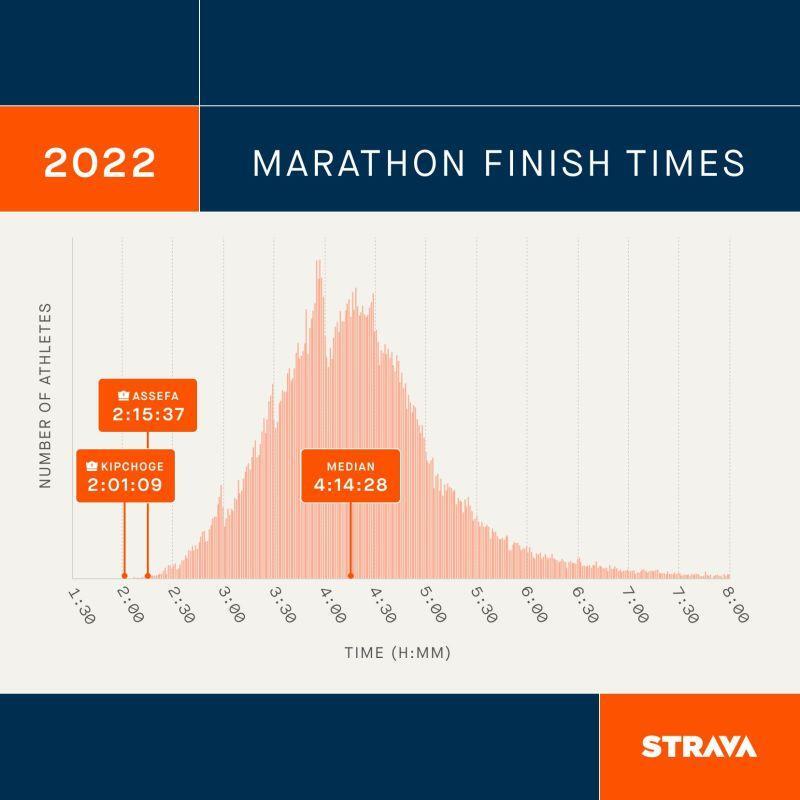
HR data can help achieve certain goals. It is important to clearly and concretely define the goal you want to achieve. The overview below from Strava shows how strong the impact of a specific finishing time can be.
At first glance, you see the normal distribution you would expect. But if you zoom in further, you can see what happens around finishing times such as 3h, 3h30, 4h and 4h30. The extra mile is run to make sure runners finish just below these round finishing times. Probably runners like me who keep a close eye on their fitness tracker. 😉
You can find more information about this via this link.
I also notice, through the use of my fitness tracker, that setting goals helps. One of my goals, for example, is to achieve at least 6,000 steps every day. I know, that is not particularly ambitious. But there have been many occasions when I have decided in the evening to go for a 10- to 15-minute walk in order to still reach my target of 6,000 steps. Simply to see my goal achieved in a nice visual. Did we already mention that rewards work? – see point 1 😉
You do not have to look far for the link with HR data. Can HR data, for example, help you answer emails less frequently during the day in order to prevent exhaustion? Or help you connect with different colleagues more often so that you become more energised or ideas spread more quickly throughout the organisation? Choose good objectives, because as you can see, they can encourage you to behave accordingly.
3. Data is a good aid for our unreliable memory
“I’ve really been very active over the past few weeks.” That was something I often thought before I had a fitness tracker. Now that I do have a tracker, I know that my memory is not always my strongest asset. Because sometimes it turned out that the amount of activity was actually rather limited. (And it wasn’t because I had forgotten to switch on my tracker 😉)
Sometimes it is good to fall back on the data and look at what really happened. And not rely solely on experiences and gut feeling. For example, there was a hospital where many employees at one point got the impression that a large number of staff members were leaving the organisation.
When the HR department took the initiative to map the organisation’s turnover data, it turned out that turnover had not increased significantly, except in one specific department. With this message based on objective data, a great deal of calm quickly returned to the workplace. So let data support our memory where needed.
4. Automatic nudging helps
Sometimes it does surprise me. But in most cases, it is very effective. After 15 to 20 minutes, my watch signals that I have been sitting down for too long. You will not hear me say that I immediately jump up and start walking, but in many cases I find it a good reminder to briefly get moving.
This insight also applies to HR data. Feedback that you receive when displaying certain email behaviour, for example, can help change that behaviour. But a ‘nudge’ to, for instance, have lunch with colleagues more often (thereby further stimulating the spread of ideas within your organisation), can certainly help as well.
Want to know more?
Would you like more inspiration on HR analytics? Then be sure to subscribe to our bi-monthly newsletter for tips and trends, or contact us.