
Is ChatGPT an added value for HR professionals? We put it to the test!
18.04.2023Artificial intelligence (AI) and machine learning have become impossible to ignore in the business world today, especially when it comes to HR. Technological advances have enabled us to automate and optimise numerous tasks. One of the biggest AI developments of recent years is ChatGPT, an advanced language model capable of understanding and generating human language. But what exactly can ChatGPT mean for HR? In this blog post, we share the added value of ChatGPT for HR through 5 concrete applications that we have tested ourselves.
Reviewed by Lotte Van der Sijpt
More than understanding human language
ChatGPT was developed by OpenAI, a research company focused on the development of artificial intelligence. Since the summer of 2020, ChatGPT has functioned as a language model capable of generating human-like text. Even more interesting? It is also capable of understanding human language and responding to it.
Whether you ask it a question about the history of HR or present it with a mathematical problem, ChatGPT can quickly formulate a clear answer. By taking various factors such as context, grammar and semantics into account, it tries to produce the best possible answers to your question. Because its algorithms have been trained on enormous amounts of data, its margin of error remains very small. Do you still notice a mistake? Then be sure to point it out, as the model immediately learns from it and uses your continuous feedback to revise its own answers.
1. ChatGPT as a creative assistant for HR professionals
As an HR professional, creativity is an important asset. Coming up with attractive job titles, creative campaigns and catchy hashtags for LinkedIn are just a few examples of situations in which you can put your creative skills to use. But sometimes it can be difficult to quickly come up with new ideas. This is where ChatGPT comes in handy.
Thanks to its ability to understand and generate human language, it can quickly and easily generate new ideas and options. From fake names for companies and candidates that you can use when anonymising mock-ups and business cases, to coming up with attractive titles for a meeting or campaign. Simply ask the question and soon you could be promoting a fun book giveaway with the hashtag #BoeKado or calling your weekly internal Monday meeting the Starfish Power Hour from now on.
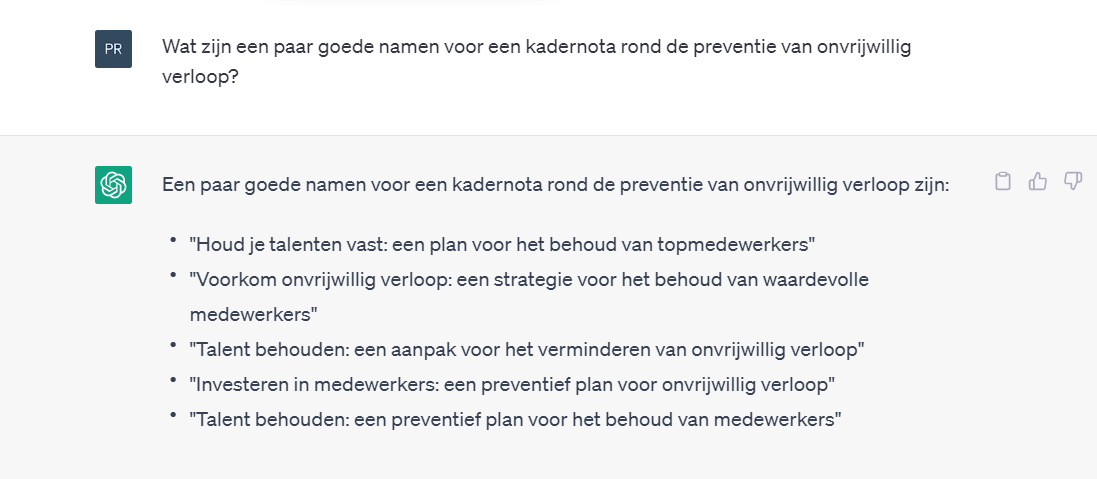
ChatGPT, OpenAI. (2023). Screenshot of chat.openai.com. OpenAI - Names for policy paper. https://chat.openai.com/
2. ChatGPT as a talking calculator
ChatGPT is not only useful for generating creative ideas, but is also a valuable tool for performing calculations. Whether it concerns simple mathematical formulas or more complex calculations, ChatGPT can quickly and accurately provide answers to a wide range of calculation-related questions that HR professionals may have.
For example, it can help calculate percentages, convert currencies or prepare financial reports. If you have a quotation for a service and want to know the price after applying a 20% discount, ChatGPT can give you the correct amount within seconds.
But ChatGPT can also assist with more complex calculations, such as calculating the labour costs of an employee, including taxes, pension contributions and social security contributions. The answer depends on how much input you provide, but in general the model will always make an initial estimate and highlight important considerations such as differences between sectors and social security contribution rates.
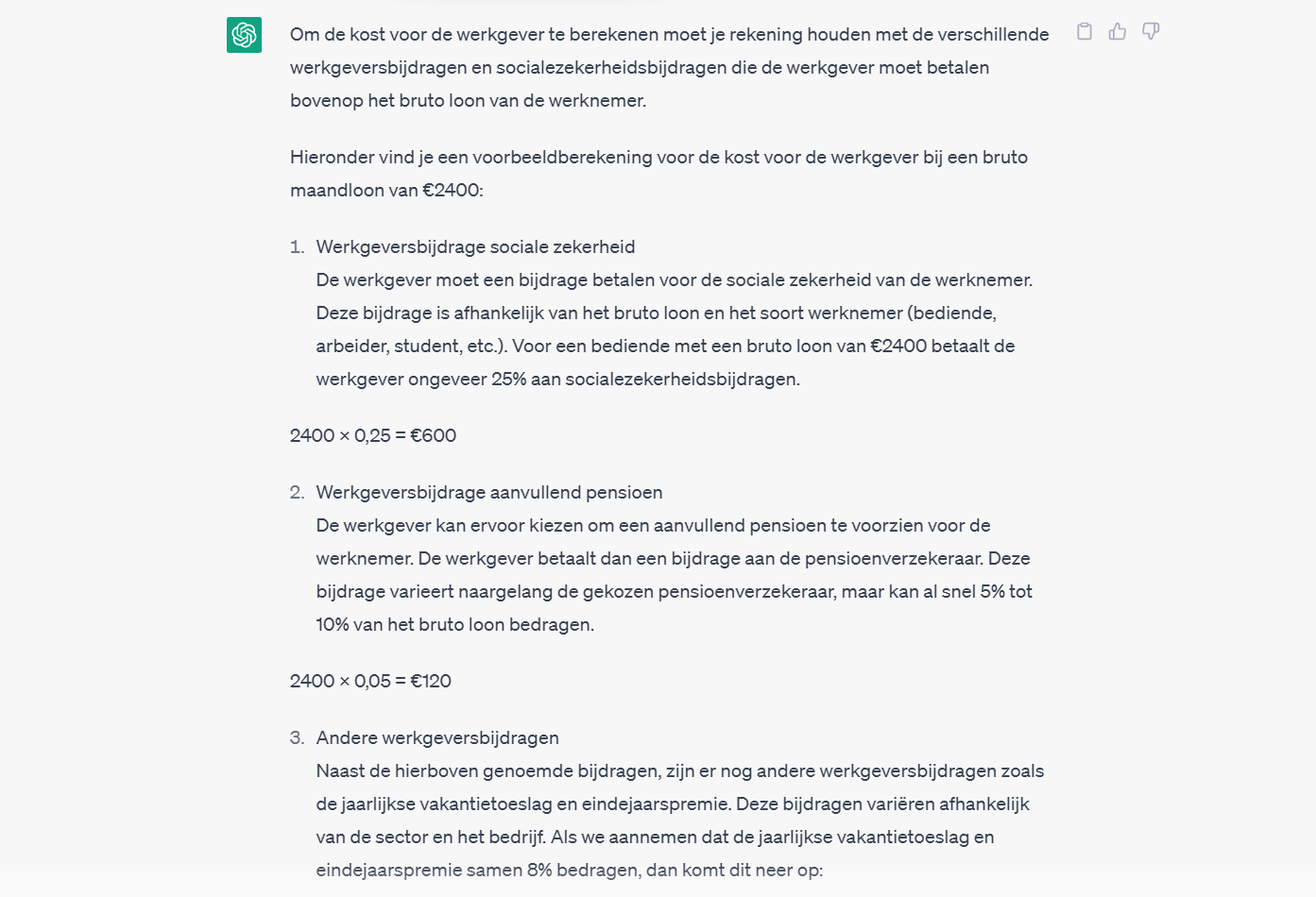
ChatGPT, OpenAI. (2023). Screenshot of chat.openai.com. OpenAI - Calculating employer costs. https://chat.openai.com/
3. ChatGPT as a concrete translation of HR concepts
Another advantage of ChatGPT for HR professionals is its ability to make complex concepts more concrete. It can sometimes be difficult to translate abstract concepts, such as policy measures or legal texts, into workplace practice. ChatGPT can help by providing practical examples that make these abstract concepts more tangible.
For example, if you summarise a new legal text on ‘the right to disconnect’, which states that an employee may not suffer negative consequences if he or she is not reachable after working hours, ChatGPT can generate examples of what these "negative consequences" might actually entail. These can range from continuous pressure from the employer to remain reachable to the loss of promotion opportunities. By providing these concrete examples, ChatGPT can serve as inspiration or support for HR professionals when translating and communicating concepts to the workplace, helping to ensure that abstract concepts become understandable and practical.
4. ChatGPT as a multilingual and versatile language assistant
You may already have noticed that ChatGPT performs just as well in Dutch as it does in English. But ChatGPT is more than just a multilingual language assistant. In addition to speaking more than 50 languages, ChatGPT is also highly versatile in its use of language. The model can also adapt the tone of its responses to the situation and its conversation partner.
If you ask a question in an informal or cheerful way, you can expect the same tone in return. You can also explicitly indicate the type of tone in which you would like your answer. This is very useful for HR professionals who are looking for tools to make a text more persuasive or, on the contrary, more informative.
Finally, when formulating an answer, ChatGPT can also take your level of knowledge about the subject into account. For example, if you ask for an explanation of the gender pay gap at a child's level, you will actually receive simpler terms and less jargon than if you request an explanation at an expert level.
5. ChatGPT as a collaborative colleague
ChatGPT is not only a language assistant that provides information and answers questions, but it is also perfectly suited to collaborate with as a partner. If you want to test an idea or quickly extract an insight, the language model is there for you as well. ChatGPT is capable of further refining and analysing input that you provide yourself. For example, if you provide a written text about a SWOT analysis, you can ask it to generate a clear overview of strengths and pitfalls. This saves you time as an HR professional and makes it easier to understand the key points of your own analyses:
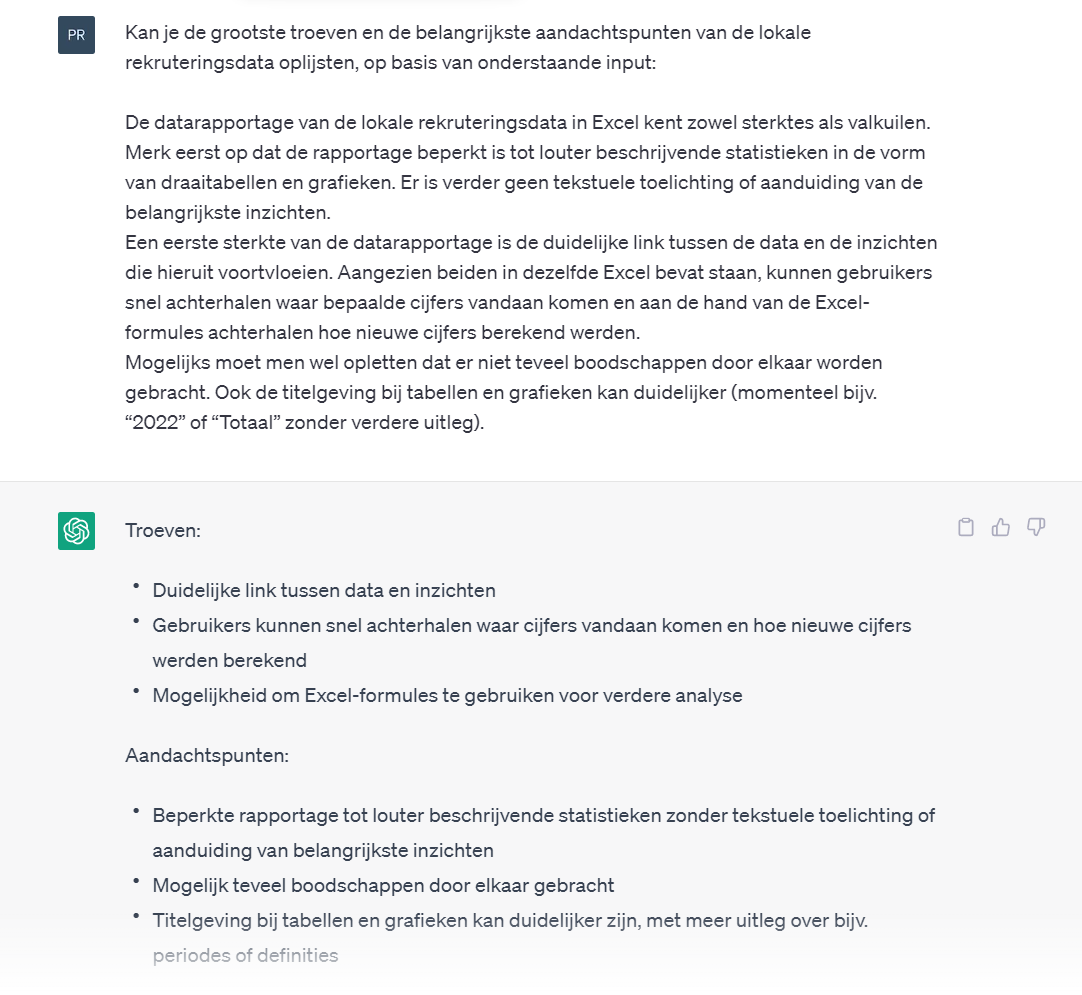
ChatGPT, OpenAI. (2023). Screenshot of chat.openai.com. OpenAI - Report Information Summary. https://chat.openai.com/
Conclusion
ChatGPT offers a range of benefits for HR professionals. You can rely on fast and efficient support in creating content, translating abstract concepts and policy documents, and communicating with employees. Thanks to ChatGPT's versatility and multilingual capabilities, you can also communicate in an appropriate and clear manner with conversation partners of different levels and backgrounds. Don't believe me? Then know that this blog post was only reviewed by us, but otherwise written by ChatGPT itself. Go and discover for yourself what ChatGPT can mean for your HR work!
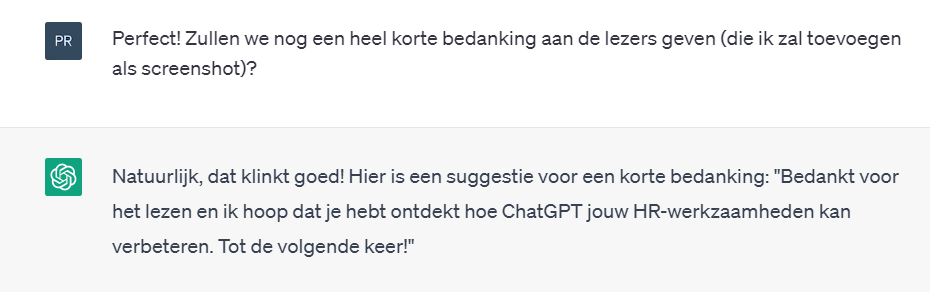
ChatGPT, OpenAI. (2023). Screenshot of chat.openai.com. OpenAI - ChatGPT blog post. https://chat.openai.com/
Want to know more?
Would you like to try this powerful language model yourself? Then you can create a free account via OpenAI and visit ChatGPT yourself.
Would you like even more inspiration on HR analytics and AI in HR? Then be sure to subscribe to our bi-monthly newsletter for tips and trends, register for our next free webinar, or contact us.