
Successful hybrid working? Clarity, social capital and career growth are the three keys.
15.11.2022Hybrid working is becoming increasingly popular and the number of remote workers continued to rise even after the COVID measures were lifted. Nevertheless, the impact that a completely new way of working has on your organisation should not be underestimated. How can you ensure it becomes a success story in your organisation? According to Microsoft's Work Trend Index from last September, the data point to three clear factors that employers can immediately start working on: clarity, social capital and career growth.
Read on to discover why these principles are so important and how you can concretely integrate them into your company to make hybrid working run more smoothly.
Written by Lotte Van der Sijpt
Hybrid working, a term that encompasses all kinds of combinations between traditional and virtual work arrangements, remains a major challenge for many organisations. With its growing popularity among employees, hybrid working is no longer discussed as a trend, but as the actual future. Various business reports this year confirm the strong trend towards remote and virtual working.
One of these reports is the Work Trend Index. Every spring, Microsoft publishes data-driven insights to help employers navigate these constantly changing times. Throughout the year, these are also bundled into pulse reports on important workplace challenges, both in and outside the workplace, such as hybrid working. Their latest pulse report from September included a survey of more than 20,000 employees across 11 different countries. Combined with productivity data from their Microsoft 365 suite and LinkedIn’s labour market trend data, Microsoft identified three counterproductive tipping points in hybrid working.
Would you like to assess whether, as an employer, you are falling into the same traps and, if so, learn how to turn the story back into a success? Then discover the three most important insights from the report below:
1. Stop the productivity paranoia
There is a large gap between how productive employees are and how productive their employer believes they are. This peak during times of hybrid working is not entirely illogical. When employees are working at their desks at home instead of clocking in for the same hours at the office, employers have less visibility over their activities. Seeing productivity is an important precursor to believing in productivity.
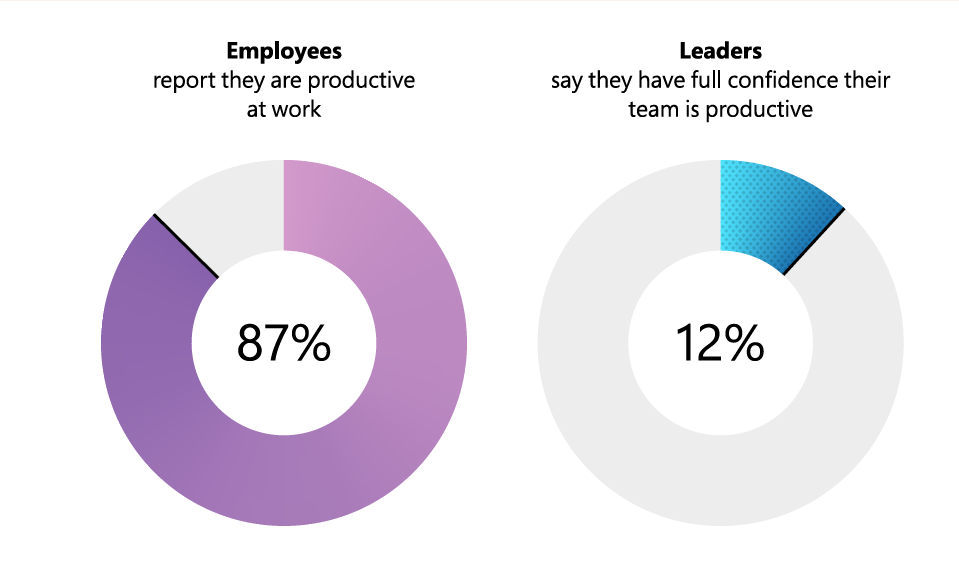
Microsoft. (2022, September 22). The gap between how productive employees are and how productive employers think they are. Hybrid Work Is Just Work. https://www.microsoft.com/en-u...
Employers must nevertheless move away from this. It is dangerous not to have enough trust in your employees and to place additional pressure on them to prove their own productivity. Instead, it is better to use that energy to support your employees.
What should you do?
- Help employees set priorities. Including what they should not do and what they should (temporarily) put aside in favour of more important tasks. Simply reordering a to-do list is not enough.
- Employers should shift their focus from productivity to impact. Look at whether your employees deliver results instead of merely looking at the number of hours they have worked.
- Listen more to employee feedback when making decisions, and also provide employees with more feedback about why certain decisions are made.
2. Embrace the fact that employees are not returning to the workplace for you
The survey shows that the main added value of working from the office again is the people. Employees mainly return for the social aspect, not the work aspect. What makes an office better than a desk at home is the opportunity to see your work friends again and strengthen the bond with your immediate team members, something that can sometimes be more difficult through purely digital channels.
Another striking finding is that it is mainly the younger generations who need this. They are happy to return if it means having their colleagues around them. One possible explanation is that younger generations are only just starting out in the labour market and still have to find their place in their job. They want to get to know colleagues better in order to expand their social network. Plus, when you are new, it is always useful to have someone nearby to ask all your questions.
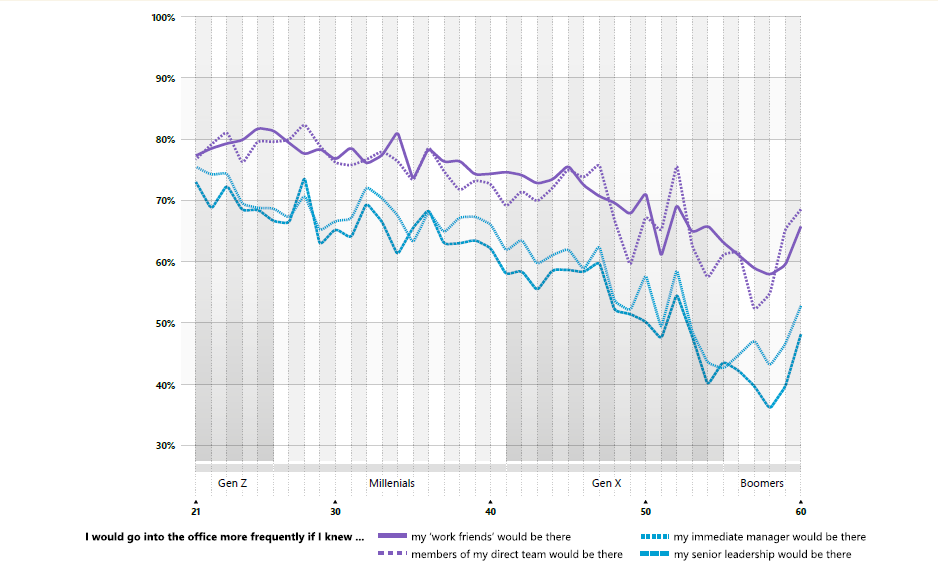
Microsoft. (2022, September 22). Reasons for returning to the workplace according to different generations. Hybrid Work Is Just Work. https://www.microsoft.com/en-u...
How can you respond to this?
- Actively help rebuild employees’ social capital. Make the most of the face-to-face time they have with each other, even if it is just by doing a “how was your weekend?” round at the start of a meeting or a small team-building exercise.
- Make use of digital channels and digital communication to keep employees connected with each other, with managers and with the organisation, regardless of distance. Be careful! The communication should feel authentic rather than simply serving as another informational channel.
- Consider creating an online community with interesting discussion topics where employees can engage with and learn from one another.
3. Recruit your employees again
Focus on renewing your own talent. Do this by embracing new trends, such as prioritising learning and development (L&D). Given the dynamics of today’s labour market, your organisation constantly needs new skills, but your employees also need them to perform their jobs well. Many people, especially younger generations, believe that they will only acquire new skills by changing jobs. So if you cannot support your employees’ need for knowledge and skills through L&D, you may end up losing them!
What can you do?
- Make learning and growth key messages for your employees by making the right L&D resources available within the daily work rhythm. This can, for example, be financial in terms of training and software, but especially collecting and structuring information relevant to the job and providing sufficient time to learn from it already helps enormously.
- Make internal mobility a priority. Focus more on horizontal promotions instead of vertical promotions so that employees can experience different roles and new tasks within the organisation, rather than only being presented with more responsibility.
- Build an internal talent marketplace. Map out which skills someone possesses as well as which skills others are lacking. In this way, employees already close a large part of the gap between existing and required skills internally.
Want to know more?
Would you like more figures on hybrid working? Then you can certainly explore Microsoft's full report in more detail.
Would you like even more inspiration on HR analytics? Then be sure to subscribe to our bi-monthly newsletter for tips and trends or contact us.