
Predicting employee turnover with LinkedIn data? It can be done!
13.02.2023Challenge number 1 for many companies today? Finding and retaining good employees. Reducing employee turnover is therefore one of the priorities for many companies. Not surprisingly, because employee turnover is costly, disruptive and time-consuming. Fortunately, modern technology has made it possible to predict employee turnover more accurately and quickly. By leveraging the power of HR data and machine learning, publicly available LinkedIn data can predict the departure of your employees with up to 88% accuracy.
Predicting turnover = preventing turnover (including the costs)
Turnover is a common dynamic within organisations. Some employees leave the organisation naturally, for example because they retire or because their contract comes to an end. In most cases, however, an employee's departure comes as an (unpleasant) surprise. How does someone arrive at the decision to resign?
In difficult economic times, with a great deal of instability and uncertainty, there is less demand for personnel. As a result, organisations often try to reduce costs by dismissing employees. Turnover increases. On the other hand, economic growth also goes hand in hand with high turnover. This time, departures are mainly driven by employees themselves. Demand for workers in the labour market increases and new job opportunities become available everywhere.
Regardless of the economic scenario, high employee turnover can be harmful to organisations and lead to material costs related to dismissal, recruitment and training, but also to intangible costs such as loss of know-how, disruption of workflow and relationships with customers and suppliers.
It would therefore be very useful to be able to predict when one of your employees wants to leave, even in good times. Or to assess how long potential applicants are likely to stay with your organisation. One small problem: where do we get enough useful data from to make accurate predictions?
Analysing LinkedIn profiles with machine learning
In a recent Brazilian study, researchers used a crawler (software that can automatically process website pages) to collect more than 80,000 professional profiles from LinkedIn. This is hardly surprising, as LinkedIn, with more than 750 million members in over 200 countries, is by far the largest professional social network. LinkedIn data contains valuable insights that can be used to identify employees who are at risk of leaving the organisation. The researchers in this Brazilian study focused on certain employee characteristics, including their place of residence, level of education and skills, but especially their professional background and the duration of employment in their previous positions.
Once these data had been collected, the researchers applied 3 different forms of machine learning to the data. Machine learning is a form of Artificial Intelligence (AI) in which the system is provided with data and learns from and explores it independently. Machine learning excels at sorting large datasets and recognising patterns within them. The computer's task was therefore to sort the LinkedIn profiles in the dataset according to the likelihood that they would resign. Of the three different approaches, the decision tree algorithm proved to be by far the best. The decision tree algorithm filters the data based on numerous tree structures and selects the one with the highest information gain.
How long you work within organisations determines how quickly you leave again
Based on their average tenure, profiles that were likely to leave the organisation in the near future were identified. Ultimately, two levels were distinguished:
- A low tendency towards turnover: in less than 60% of job experiences, a shorter employment duration than the average for employees active in the same sector.
➜ Was the average duration of your previous job experiences longer than the average within your sector? Then you generally remained employed within organisations longer than comparable profiles did, and there was less chance that you would leave your current organisation. - A high tendency towards turnover: in more than 60% of job experiences, a shorter employment duration than the average for employees active in the same sector.
➜ The same story as above. By taking the duration across all your job experiences together and comparing this average with the sector average, you can determine that if you move from one job to another more quickly, you are more likely to leave your current job sooner as well.
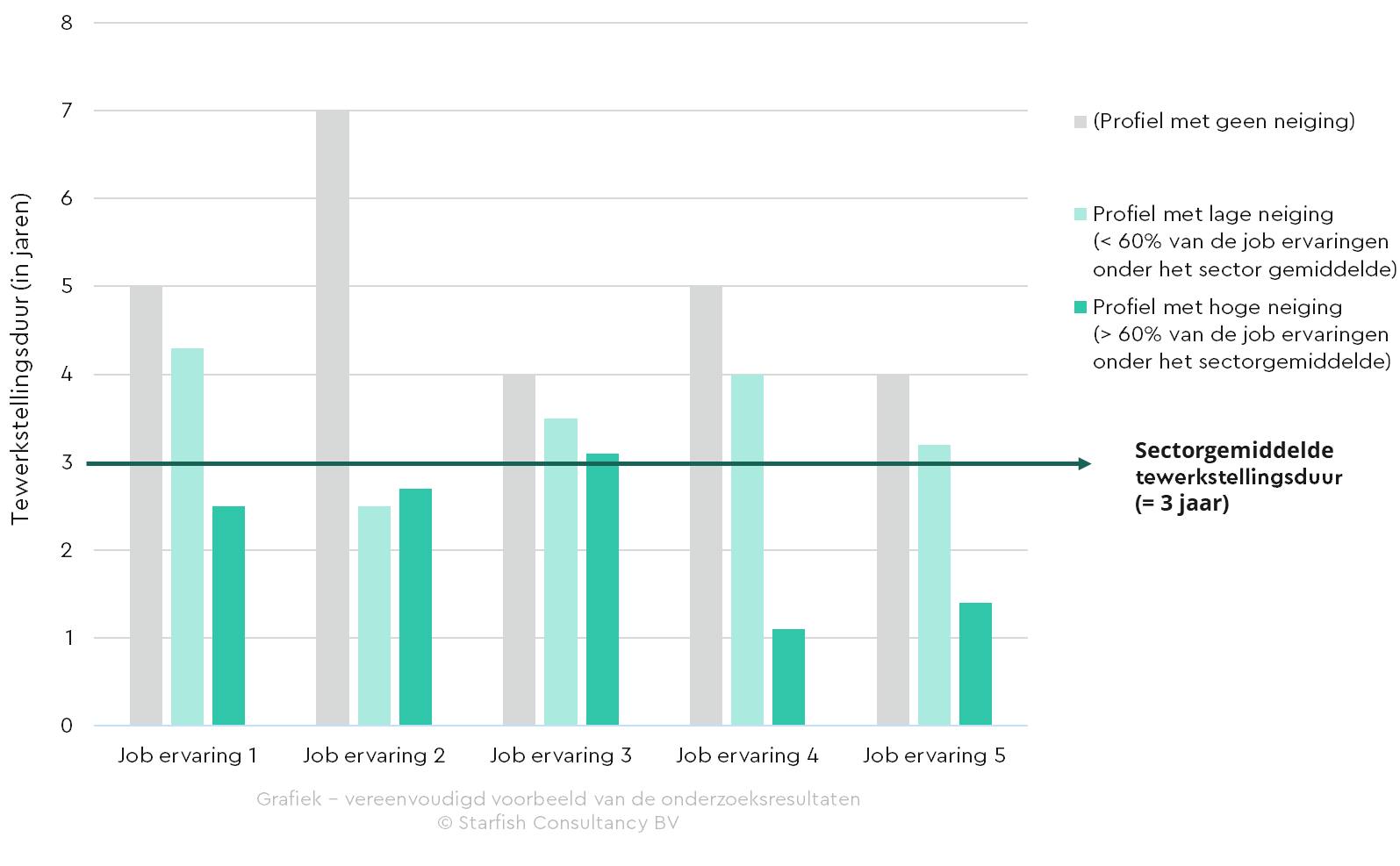
This means that you can relatively easily compare employees across different sectors using LinkedIn data alone. If an employee has worked for a shorter period than the sector average in more than 60% of their previous jobs, then that employee has a high tendency to resign. Such an employee is therefore worth monitoring closely, whether it is to keep an eye on your own favourite internal employee or to attract a potentially interesting profile that may soon become available on the job market again.
Want to know more?
Would you like to read the study yourself? Then you can download it via their Researchgate page.
Would you like even more inspiration on how to gain these insights from your own organisation through HR analytics? Or are you still looking for more concrete solutions to address challenges such as employee turnover and retention? Contact us, or subscribe to our bi-monthly newsletter for tips and trends.